
UFC 5 beginner guide: your first hour
Open Learn in the main menu, read one section of the Training Manual, then spend five minutes on it in Practice Mode. Do that before you fight anyone online.
The first hour of UFC 5 is not about winning a fight. It is about learning which of your inputs the game actually reads, and in what order. Two players can press the same buttons and get completely different results because one of them is throwing from range and the other is throwing into a block from four inches away.
Work through this page in order and you will skip the week most new players spend mashing.
Start in the Learn tab, not in a fight
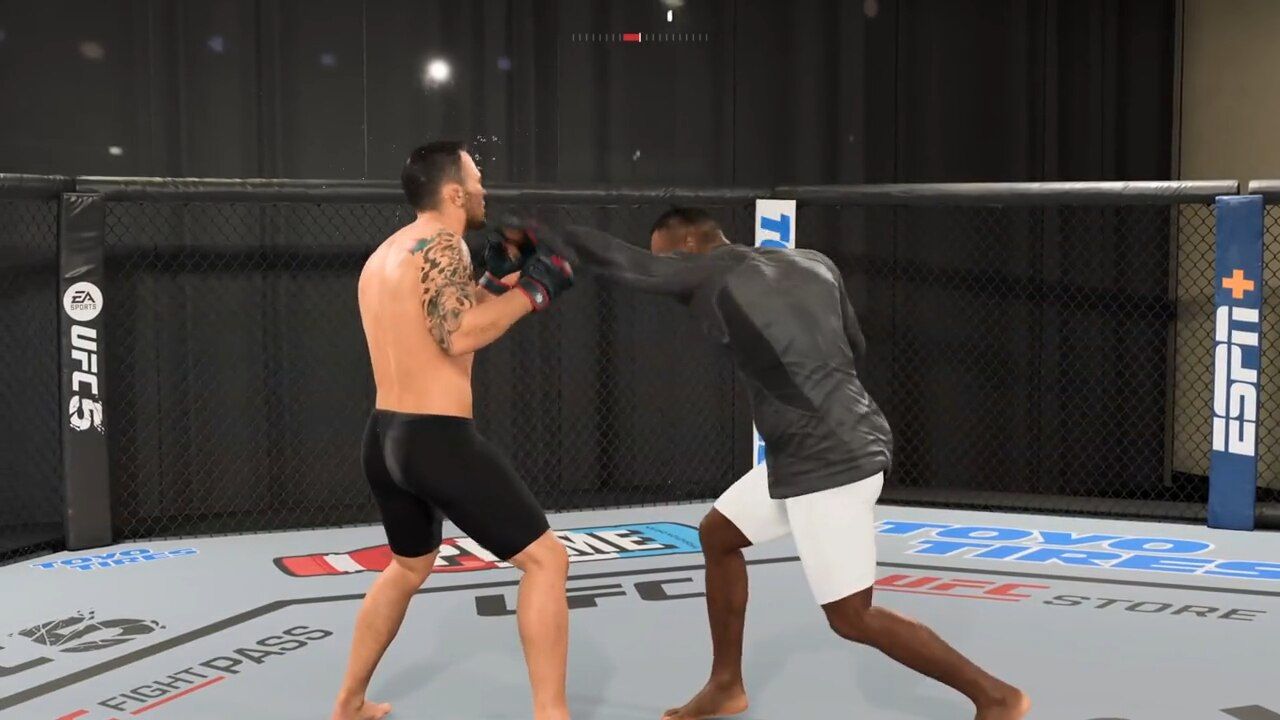
The main menu has a Learn tab holding two things that matter more than any tutorial video: the Training Manual and Practice Mode. The Training Manual explains the controls for every essential move in the game, grouped by phase — stand-up, clinch, ground. Practice Mode drops you into the Octagon against an AI you cannot lose to, with the move list one button away.
The order that works: read one section of the manual, then immediately try that section in Practice Mode for five minutes. The manual is a reference, not a course. Reading all of it before touching the pad is how people end up knowing the word "uppercut" and still losing every exchange.
Practice Mode is also where you find out which of your fighter's moves exist at all. Press pause during a fight, open Game Help, then View Moves — the list is per fighter and it is where the game tells you which strikes carry a Guard Break icon.
Pick a fighter type that matches how you want to play
Five styles split into 14 fighter types. You choose a type, not a style, and the type sets your starting ratings and perks on stand-up, grappling and health.
| Style | Fighter types | What the style leans on |
|---|---|---|
| Kickboxer | Razor, Acrobat, Sniper | Range and kick volume; Sniper is the patient counter-striker |
| Boxer | Showboater, Pressure, Powerhouse | Hands, head movement and short-range damage |
| MMA | Virtuoso, Versatile, Engine, Top Dog | Balanced; the four types cover different stamina and damage profiles |
| Wrestler | Smasher, Dominator | Takedowns, top control, ground and pound |
| Jiu-jitsu | Vanguard, Shark | Submission hunting from the first exchange |
Two practical notes. First, a Wrestler with no stand-up will still lose the first round of most online fights, because the opponent can simply back off and kick. Second, a Jiu-jitsu fighter does not need to be good at striking to win — a single takedown into a chain is often enough at low levels. Pick the style whose failure mode you can live with.
The first hour, drill by drill
- Ten jabs, standing still. Straight punches come from the lead hand and are your measuring stick. Throw ten in a row and watch the range at which they land.
- Block, then block low. Hold block for head, add the body modifier for body. Notice that the guard animation changes and that repeated blocks in one lane leave the other open.
- One takedown, both directions. Single leg and double leg are the two every fighter has. Do each three times and watch how the grapple advantage bar at the top of the screen moves before the attempt.
- One submission attempt, no finish. Get a takedown, advance position, start a submission, then let it go. The point is to see the meter and the denial window without the pressure of a finish.
- One round of pure defence. No strikes for ninety seconds. Block, move your head, lunge out. This is the single most useful drill in the game and almost nobody does it.
- One round of pure body work. Body kicks and body hooks only. Body health drains slower than head health and it opens knockdowns that head hunting never gets.
Four inputs that carry the stand-up game
| Action | PS5 | Xbox | Why it matters first |
|---|---|---|---|
| Straight / jab | Square or Triangle | X or Y | Fastest way to measure and interrupt |
| Hook | L1 + Square / Triangle | LB + X / Y | Close-range damage; catches lateral movement |
| Block head / body | R2 / R2 + L2 | RT / RT + LT | The default state you should return to |
| Minor lunge | Flick left stick | Flick left stick | Repositions without committing to a strike |
Everything else — spinning attacks, catch kicks, clinch entries — is a modifier on top of those four. Learn them in that order and the advanced pages will read as variations rather than new systems.
What to ignore in week one
Spinning kicks look spectacular and cost you the fight, because Strike Vulnerability climbs while you are mid-animation and your opponent gets grapple advantage for free. Advanced kicks are a counter-punching tool for later, not an opener.
Ignore the entire clinch for the first few hours as well. It is a legitimate part of the game, but the clinch has its own entry inputs, its own strike set and its own transitions, and learning it before you can block a hook just adds confusion.
Finally, ignore the store. Cosmetics change how a fighter looks; none of it fixes a stamina problem.
Beginner mistakes that cost the most
- Mashing. Every extra input while at low stamina permanently reduces Maximum Stamina. The game does not stop you; it just makes the next round worse.
- Throwing from out of range. A whiffed strike drains stamina and deals nothing. If your straight punch is not reaching, step in first.
- Blocking one lane forever. Block too many head strikes and your fighter braces, which opens straights and hooks depending on where the guard drifted. Move away instead of holding.
- Panicking on the ground. The ground game is a direction-matching game: hold the block trigger and match the direction your opponent transitions. Button mashing on the bottom is the fastest way to get submitted.
Next: PS5 controls · Xbox controls · Striking offense